Monday, 2 July 2012

mythos -ou m. tale, story; graphé -és f. writing

I am teaching an 8-week workshop to students in their last year of high school. The workshop can be on anything as long as it is in English (the students are Chilean). With such a wide brief, how could I resist doing something classical? The only small problem is that in all the other workshops the students are "watching movies" (film study) so my workshop couldn't be purely literary. And so I combined my love of mythology with my interest in photography. Ladies and gentlemen, I give you Mythography!

Yes, all you pedants out there, I know that the title suggests more the writing of myths rather than any picture taking, but contrivance has always been catchy, and Mythography is really catching on! The students have four lessons a week, two for mythology and two for photography.

Mythology
On the mythology side, the students read Greek creation myths, learn about Greek (and Roman) deities, study the myths leading up to the Trojan War, and watch the film Troy (there had to be a movie!). They do read an introduction to Homer and the Iliad beforehand in order to compare Hollywood's interpretation with the original.

The Olympian Gods
The gods lend their names to our study of mythology and the English language.

Photography
On the photography side, we learn about the composition of photographs - focal point, background, simplicity, rule of thirds, lighting, colour, lines, framing, balance and movement. These rules of composition are taught during class, and students then have the opportunity to practise taking photos around the school using these new ideas. There is also a short lesson on cinematography and film study based on Troy.

Photography
The rules of composition are a useful skill to take outside the classroom.

Language
There are also a few fun language elements in the course, such as word power and ancient Greek! The students decipher the stories behind the naming of the planets and the days of the week (Spanish and English). They also complete a reading comprehension based on Peter Jones' article "The wrong ancient gods" about the commemorative coins for the 2012 London Olympic Games. They have to design their own coins (with Greek gods, of course) and have a short lesson on the history of the Olympic Games and the use of Greek and Latin numbers in English.

Students also have the opportunity to learn the ancient Greek alphabet, as well a few appropriate transliterated words.

Greek Alphabet
Students learn Greek words which have come into English directly (e.g. athlete).
They also write their own names in ancient Greek!

Projects
In order to test the Mythography aspect of the workshop, the students complete 3 projects. Project 1 is after reading the myth of Pandora's Box. In groups, the students create their own enticing Pandora's "pythoi" (vessels). The Evils are all photographs by other photographers, while Hope is a photograph they have taken themselves using the rules of composition learnt in the course. The images all have to be linked (through subject - e.g. children, or through use of color - e.g. black & white).

Pandora's Box
The inside holds 6 photographs of children in desperate situations,
and 1 beautiful photograph of Hope, a happy, smiling child.

The main assignment is a visual and written task in which students compose and capture three images relating to the myths leading up to the Trojan War. The subject matter of these images can be any elements suggested in the myths (love, judgement, war, etc.). The students also write a paragraph on each image explaining the idea and elements of composition behind each picture.

'The Apple of Discord'
Eris' "gift" to Peleus and Thetis at their wedding.

The ultimate project is an oral presentation based on the film Troy. In pairs, students analyse a theme from the movie, looking at cinematography and character development. Hopefully all the background lessons on mythology and photography lend an insight into their analysis.

Troy
Hollywood's version of the great epic poem.

And that is Mythography, a combination of mythology and photography. I believe that the photography skills will be useful to the students for the rest of their lives, while the mythology aspects will enrich their knowledge now, and hopefully allow them to contribute interesting snippets to conversations for years to come. Or at least give them the answer to the deciding question in a pub quiz!

Saturday, 27 March 2010

villa villae f. country house, villa

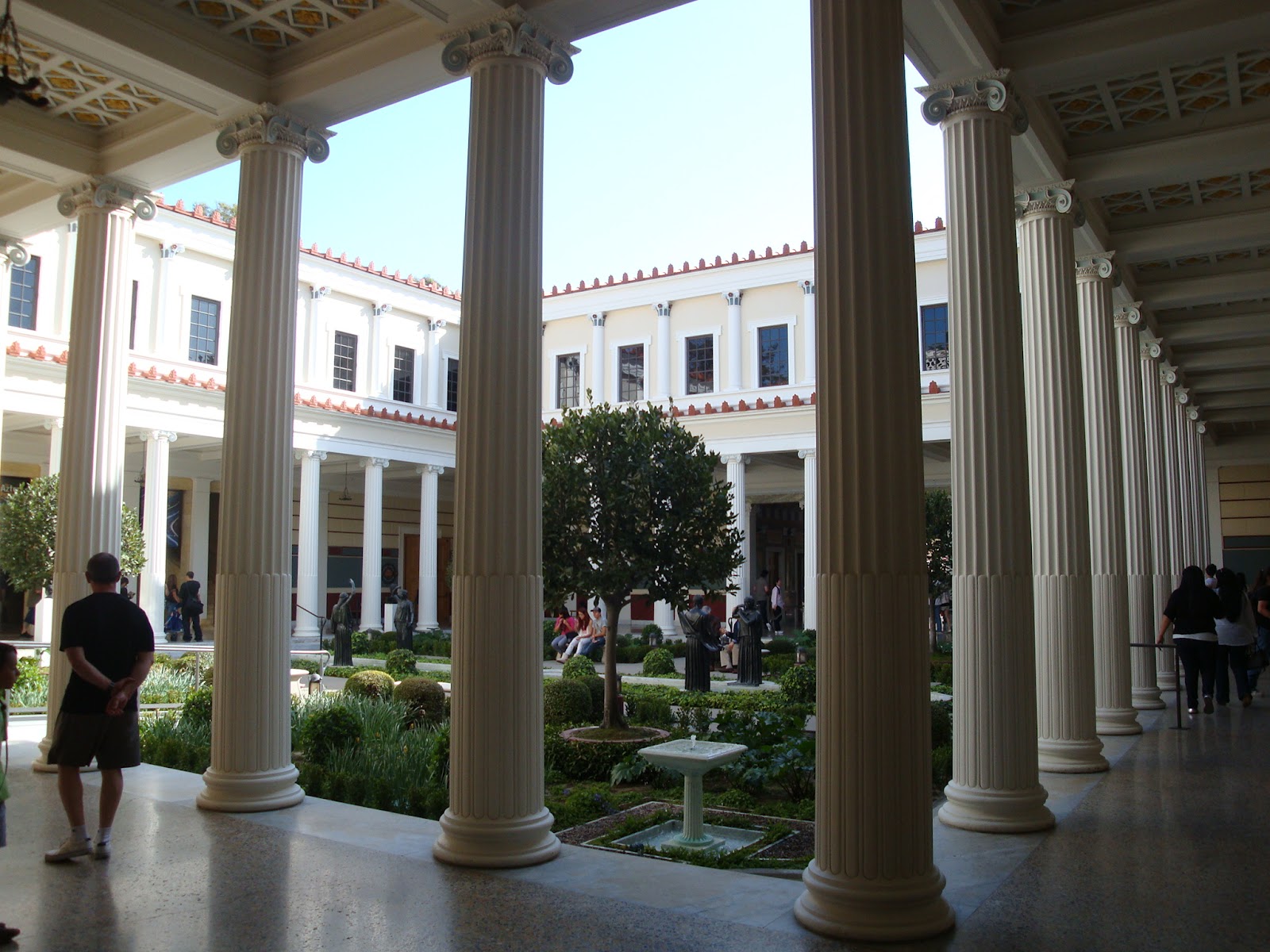
On a recent trip to Los Angeles, I visited the Getty Villa, a museum built to house oil tycoon, J. Paul Getty's, collection of classical antiquities. The villa is everything I dream of creating one day. It is a recreation of an ancient Roman villa, the Villa dei Papyrii, on the slopes of Mount Vesuvius in Herculaneum.

The attention to detail in the complex is amazing, right down to the mosaic on the atrium floor and the fresco in the outdoor peristyle. Each feature of the house takes its inspiration from different houses in Pompeii and Herculaneum, such as the House of the Fountain.

Jupiter

impluvium in the atrium

Central courtyard

Outer peristyle


Thursday, 25 February 2010

culter -tri m. knife

I recently spent two weeks in England and, once again, I endeavoured to factor museums and ruins into my trip. I visited the Great North Museum in Newcastle which boasted an eclectic display of everything from dinosaur fossils to a Newcastle United football shirt (?). It also included unique exhibitions of ancient Roman and Egyptian artefacts.

The Roman section was largely based around Hadrian’s Wall, and focused primarily on the structure of the wall, as well as artefacts buried on site. I was enchanted with this little bone carving of a boy soldier. On closer inspection it turned out to be a beautifully crafted switchblade! I never knew that the Romans had pocket knives, but in my book, this beats a Swiss Army Knife any day.


Tuesday, 2 February 2010

declamatio -onis f. practice in public speaking

On Saturday 30 January the ASD Declamation Contest was held. This is an inter-schools' competition in which contestants answer a culture quiz, declaim a poem, and (for the modern languages) perform a dialogue or impromptu speech. The languages are Spanish, French, German, Japanese and Latin.

I was asked to judge the Latin Poetry section, which was quite exciting. The syllabus was chosen by Glenn Wright and included the following poems:

First Year: Catullus 5, Horace, Odes III.13, and Vergil, Aeneid IV.621-629
Second Year: Catullus 101, Horace, Odes I.5, and Vergil, Aeneid I.1-11
Third Year: Catullus 3, Horace, Odes III.2, and Vergil, Aeneid II.270-282, 289
AP Latin: Catullus 35, Horace, Odes I.22, and Vergil, Aeneid VI.450-471

To be honest, the competition was a bit stale, as there were only six contestants, all from South High. Most contestants rattled off the poem parrot-style, and failed to understand the meaning behind it. Poor old Catullus at his brother's tomb was positively delirious with joy, while the Fountain of Brundisium was barely trickling through the gloom.

It was quite challenging to judge as some of the criteria were, in my opinion, unbalanced. 15 marks were allocated to memorization, while only 7 to capturing the meaning of the poem. A student could get 3 marks for speaking at the right volume and 5 for being confident, regardless of the quality of Latin. I would have preferred more marks for the actual Latin and fewer penalties for memory loss.

I have been asked back to judge the State Finals in February. As there are no other schools which offer Latin in Alaska, it'll be the same five contestants again (one of the second years pulled out after her first poem). I hope that in the next three weeks, they can learn the meaning behind their poems and deliver them a little less like nursery rhymes, and a little more like the great poems they are.

Tuesday, 5 January 2010

opus operis n. work

My first year Latin pupils completed a series of projects, the first of which was a Roman dinner party in the manner of ‘coquus –i’ below. The boys were introduced to Roman dining through a series of fun worksheets and, of course, through a sample of dishes made by yours truly. I prepared sweet wine cakes, cheese discs, honey biscuits, pates and grape juice, and rounded off the meal with dormice (aka marshmallow mice!).

In the middle term the boys studied some myths and legends and prepared posters and presentations on the Olympian gods and other deities. It was good for them to share their research with the class orally.

Finally, the boys finished off the year by becoming archaeologists. We watched a documentary on Pompeii during class, and the boys got the following project brief:


Discovery in Pompeii

As you and your team of archaeologists were digging through the ruins of Pompeii, you found a diary hidden in the rubble of the forum.

In groups of 2-3 choose five aspects of life in Pompeii and write one diary entry on each aspect. You must have at least five diary entries. Mention everyday events (e.g. family, friends, pets, food) and places in Pompeii.

Introduce where and how you found the diary, and whose diary it is. Write a conclusion to say how your diarist died.

Present your diary in an A4 book format. You must include pictures and a bibliography. It must be 6-10 pages long.


I wanted them to research the lost city and present their findings in a more interesting way than just information under headings. We visited the school museum which holds a collection of classical artefacts donated by the British Museum in London. We looked at how the lamps, terra cotta statues, fragments of amphora and potsherds could be used to work out what ancient life was like.

The project worked really well, and the boys threw themselves into the research, writing and presentation of their diaries.

My next goal will be to theme these projects more constructively with the grammar sections so that all aspects of the ancient world (language and culture) tie in.

Monday, 14 December 2009

disco discere didici - to learn

Magistra will be getting a new lease on life as I share my lesson ideas for teaching Latin. My focus has been on revitalising Latin and proving that it is not a dead language (it has just been very cunningly hidden for a while!). Latin is in fact all around us and it is just waiting to be revealed.

I am looking at creating a new series of worksheets and teaching aids that use all sorts of media for teaching Latin. I’d like to teach different grammar sections under classical culture themes, using documentaries, movies, slide shows, interactive group work, fun activities, excursions, dialogues, speeches, classroom posters, etc. The possibilities are endless!

Magistra will become a forum for sharing the lessons that I have already taught and for discussing any new ideas that flow in. I look forward to any feedback.

Wednesday, 12 September 2007

iter -ineris n. journey


I've been back from my holiday around Europe for nearly two months and I still haven't posted any photos from our trip. Here is a selection of some of the best - all ruins, of course!

Friday, 31 August 2007

paideia, -eias f. education

Ancient education began with learning to read and write and later progressed to the reading of Greek and Latin authors, grammar, literary criticism, arithmetic, geometry and algebra. It also included music, rhetoric, philosophy and astronomy. From the Hellenistic period onwards, the whole collection commonly went under the name enkyklios paideia, whence we derive our English word, encyclopaedia.

pater, -eros m. father; kleos, -ou n. fame

In the ninth book of Homer's Iliad, Phoenix tells a story to Achilles about Meleager and his wife, Kleopatra. The tale is an attempt to lure Achilles back into the fighting. As it is he goes on to lose his closest companion, Patroklos, before he overcomes his pride. There is no myth surrounding Achilles' mentor, and Homer might have made up the story of Meleager and Cleopatra to compensate for this. After all Kleopatra and Patroklos are exactly the same name!

Saturday, 4 August 2007

elementa, -orum n. (pl) alphabet


This is a little rhyme which fifth century Greek children used to recite when learning the alphabet.